


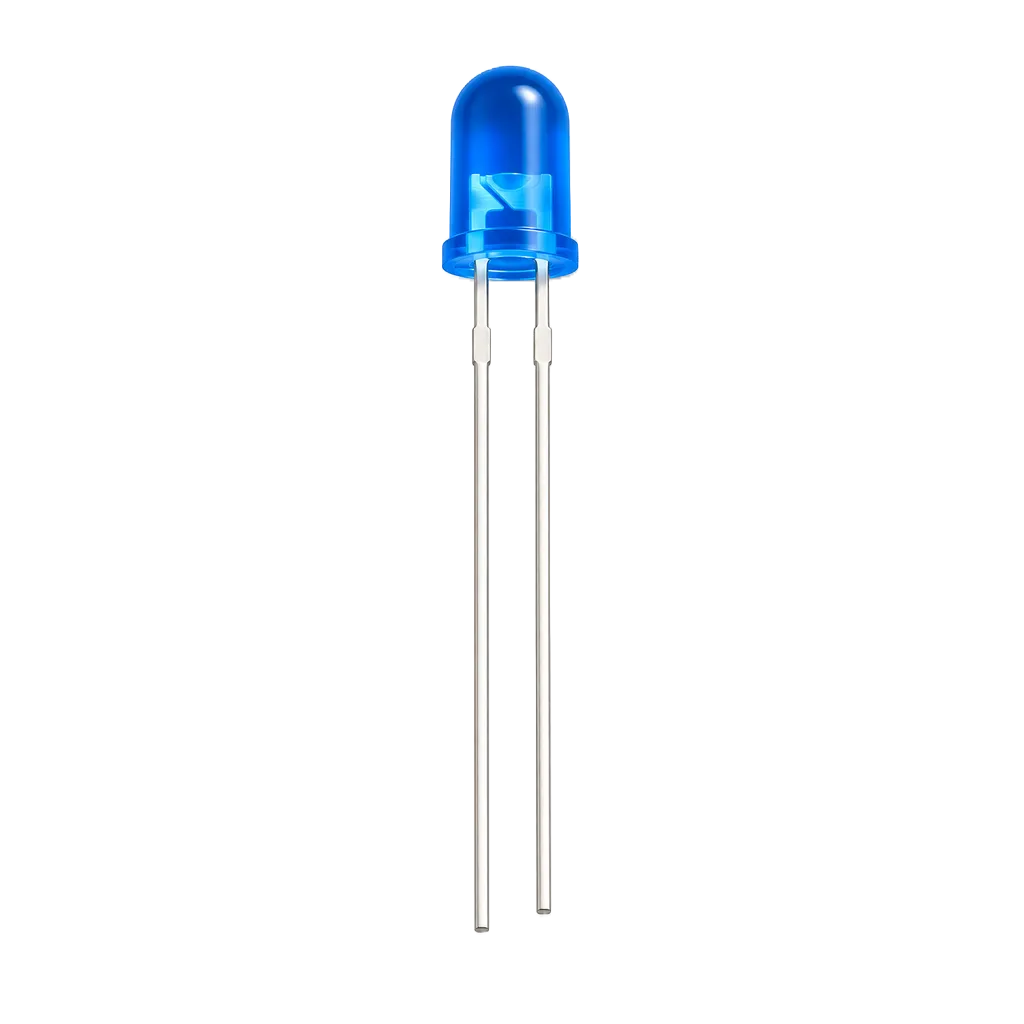
5mm Blue LED – DIP Through-Hole
The 5mm Blue LED is a compact, 2-pin DIP light-emitting diode featuring a blue-tinted transparent lens. It is ideal for electronic status indicators, Arduino projects, robotics, breadboard experiments and DIY electronics circuits.
Key Features:
- Standard 5mm blue LED
- Blue-tinted transparent lens
- 2-pin DIP through-hole design
- Typical forward voltage: 3.0–3.4V
- Suitable for breadboard and PCB mounting
- Low-power visual indication
- Compatible with Arduino, ESP32 and other suitable electronic circuits
- Ideal for status lights, decorative indicators and educational projects
Note: Use a suitable current-limiting resistor to protect the LED from excessive current.
Buy the 5mm Blue LED online from Yagobotix with shipping across India and same-day delivery or pickup available in Surat.
₹2.00 (incl. GST)
5mm Blue LED – DIP Through-Hole (2 Pin)
1. What Is a 5mm Blue LED?
The 5mm Blue LED is a compact electronic light-emitting diode designed to produce blue illumination when an appropriate electrical current flows through it.
It features a standard 5mm round body, a blue-tinted transparent lens and two metal terminals for electrical connections.
Its through-hole design makes it suitable for breadboards, PCB assembly, indicator circuits and educational electronics projects.
The 5mm Blue LED is commonly used in Arduino projects, robotics, visual indicators and DIY electronic systems.
2. What Can You Build With a 5mm Blue LED?
The 5mm Blue LED is suitable for projects such as:
- Arduino LED blinking circuits
- Electronic power and status indicators
- Robotics indicator lights
- Sensor-based alert indicators
- Electronic control panels
- Breadboard electronics experiments
- Push-button-controlled LEDs
- Miniature decorative lighting
- LED chasing light projects
- Smart home indicator prototypes
- Custom PCB indicator circuits
- STEM and engineering projects
3. Who Is It For?
The 5mm Blue LED is suitable for:
- Beginners learning electronics
- School and college students
- Engineering students
- Arduino and ESP32 enthusiasts
- Robotics hobbyists
- PCB designers
- STEM educators and trainers
- DIY electronics makers
It is particularly useful for learning about diode polarity, current-limiting resistors, digital outputs and basic electronic circuits.
4. How Does a 5mm Blue LED Work?
An LED (Light Emitting Diode) is a semiconductor component that emits light when electrical current flows through it in the forward direction.
The LED has two terminals:
- Anode (+): Positive terminal
- Cathode (−): Negative terminal
When the anode receives an appropriate positive voltage through a current-limiting resistor and the cathode connects to the electrical return path, the LED emits blue light.
Working principle:
Power Supply → Current-Limiting Resistor → Blue LED → Light Output
The LED can be controlled using a switch, transistor or compatible microcontroller.
A standard blue LED does not blink automatically. An external control circuit is required to create blinking patterns.
5. Technical Specifications
| Specification | Details |
|---|---|
| Product Type | Blue Light Emitting Diode |
| LED Diameter | 5mm |
| Illumination Colour | Blue |
| Lens Appearance | Blue-tinted transparent |
| Package Type | DIP / Through-Hole |
| Number of Pins | 2 |
| Polarity | Anode (+), Cathode (−) |
| Typical Forward Voltage | 3.0–3.4V |
| Common Reference Test Current | 20mA |
| Mounting Type | Through-hole |
| Current Limiting | External resistor required |
| Control Method | DC current / switching |
| Applications | Indicators, lighting and electronics projects |
The forward-voltage range and reference current are typical values for comparable 5mm blue LEDs. The exact electrical ratings depend on the manufacturer.
Important Operating Precautions
- Always use a suitable current-limiting resistor.
- Observe the correct LED polarity.
- Do not connect the LED directly across a 5V power supply.
- Do not exceed the specified forward current.
- Use suitable driver circuitry when controlling multiple LEDs.
6. 5mm Blue LED Pinout
The 5mm Blue LED has two electrical terminals.
| Terminal | Function |
|---|---|
| Anode (+) | Positive connection |
| Cathode (−) | Negative connection |
How to identify the terminals:
- The longer lead is normally the anode (+).
- The shorter lead is normally the cathode (−).
- The flat edge on the LED body generally indicates the cathode.
If the leads have been trimmed, verify polarity using a multimeter or a current-limited test circuit.
7. How to Connect a 5mm Blue LED to Arduino
The 5mm Blue LED can be controlled using an Arduino Uno digital output pin.
Required components:
- 1 × 5mm Blue LED
- 1 × Arduino Uno
- 1 × 330Ω resistor
- Breadboard
- Jumper wires
Wiring connections:
| Component | Arduino Uno |
|---|---|
| Digital Pin D8 | 330Ω resistor |
| Other end of resistor | LED Anode (+) |
| LED Cathode (−) | GND |
The resistor limits the electrical current through the LED.
For example, assuming a blue LED forward voltage of 3.2V, a 330Ω resistor connected to a 5V Arduino output produces approximately 5.5mA.
This is a conservative starting point for a basic LED demonstration.
8. Arduino Example Code
The following Arduino program makes the 5mm Blue LED blink continuously.
const int ledPin = 8;

void setup() {
  pinMode(ledPin, OUTPUT);
}

void loop() {
  digitalWrite(ledPin, HIGH);
  delay(1000);

  digitalWrite(ledPin, LOW);
  delay(1000);
}
How the program works:
- Arduino configures D8 as a digital output.
- The HIGH signal turns the blue LED ON.
- The LED stays illuminated for one second.
- The LOW signal turns the LED OFF.
- The program repeats continuously.
This project introduces Arduino digital outputs, LED polarity and basic timing functions.
9. Beginner Project: Push Button Controlled Blue LED
Build a simple electronic indicator using a 5mm Blue LED and a tactile push button switch.
Components required:
- 1 × 5mm Blue LED
- 1 × Arduino Uno
- 1 × 6x6x5mm Tactile Push Button Switch
- 1 × 330Ω resistor
- Breadboard
- Jumper wires
Wiring connections:
- LED anode → Arduino D8 through a 330Ω resistor
- LED cathode → Arduino GND
- Push button switching terminal → Arduino D2
- Opposite switching terminal → Arduino GND
Use the Arduino internal pull-up resistor for the push button input.
Example Arduino code:
const int buttonPin = 2;
const int ledPin = 8;

void setup() {
  pinMode(buttonPin, INPUT_PULLUP);
  pinMode(ledPin, OUTPUT);
}

void loop() {
  int buttonState = digitalRead(buttonPin);

  if (buttonState == LOW) {
    digitalWrite(ledPin, HIGH);
  } else {
    digitalWrite(ledPin, LOW);
  }
}
Project operation:
- Press the push button to illuminate the blue LED.
- Release the button to turn the LED OFF.
Make sure the button connections are made across the actual switching contacts rather than across two permanently connected pins.
This project teaches digital inputs, pull-up resistors, conditional programming and LED control.
10. Related Products
Complete your electronics project with:
- Arduino Uno R3 Compatible Programmable Board
- ESP32 Development Board
- 5mm Red LED
- 5mm Green LED
- 5mm Yellow LED
- 5mm White LED
- 5mm LED Assorted Pack of 5
- 5mm RGB LED – Common Cathode
- 5mm RGB LED – Common Anode
- RGB LED Module
- 6x6x5mm Tactile Push Button Switch
- LM393 LDR Light Sensor Module
- TTP223 Touch Sensor Module
- 330Ω Resistor
- Breadboard
- Jumper Wires
11. Related Tutorials
Explore these electronics learning topics:
- How to Connect a 5mm Blue LED to Arduino
- Arduino LED Blinking Tutorial
- How to Identify LED Anode and Cathode
- How to Calculate LED Current-Limiting Resistors
- How to Build a Push Button LED Circuit
- How to Connect a Blue LED to ESP32
- Understanding Blue LED Forward Voltage
- How to Control LED Brightness Using PWM
- How to Build an LED Chaser
- Breadboard Basics for Beginners
12. Frequently Asked Questions
What is a 5mm Blue LED?
A 5mm Blue LED is a semiconductor light-emitting diode that produces blue light when an appropriate forward current flows through it.
What is the diameter of this LED?
The LED has a nominal body diameter of 5mm.
How many pins does a 5mm Blue LED have?
It has two terminals: an anode (+) and a cathode (−).
What is the typical forward voltage of a 5mm Blue LED?
Comparable 5mm blue LEDs commonly have a forward voltage of approximately 3.0–3.4V.
Can I connect a blue LED directly to 5V?
No. Use a suitable current-limiting resistor or LED driver.
Which resistor should I use with Arduino Uno?
A 330Ω resistor is a practical starting choice for a typical blue LED connected to a 5V Arduino digital output.
Can I use a 5mm Blue LED with ESP32?
Yes. Use suitable current limiting and observe the ESP32 GPIO voltage and current limits. Brightness may be reduced when operating a higher-forward-voltage blue LED from a 3.3V GPIO.
Can this LED be installed on a breadboard?
Yes. Its through-hole leads are suitable for breadboard experiments and PCB assembly.
Can the blue LED be used as a status indicator?
Yes. It can be used as a visual indicator in robotics, electronic control panels and other circuits.
Can a blue LED blink automatically?
This standard LED does not blink on its own. It requires an external timing circuit or controller.
Can I control the brightness of the blue LED?
Yes. A compatible microcontroller can use PWM to adjust the LED’s apparent brightness.
What is the difference between a blue LED and an RGB LED?
A blue LED produces a single blue colour, while an RGB LED combines red, green and blue light-emitting elements to produce different colours.
Is this LED included in the 5mm LED Assorted Pack?
Yes. Yagobotix offers a five-colour LED assortment containing one red, green, blue, yellow and white LED.
Where can I buy a 5mm Blue LED in Surat?
You can purchase the 5mm Blue LED online from Yagobotix with same-day delivery and pickup available in Surat.
13. What Is Included?
- 1 × 5mm Blue LED – DIP Through-Hole
Resistors, microcontroller boards, breadboards and jumper wires are not included.
14. Compatibility
The 5mm Blue LED can be used in suitable electronic circuits involving:
- Arduino Uno
- Arduino Nano
- Arduino Mega
- ESP32
- ESP8266
- Raspberry Pi GPIO
- STM32 development boards
- Breadboard circuits
- Custom PCB designs
- Battery-powered indicator circuits
Use suitable current-limiting resistors and ensure that the supply voltage and controller output are appropriate for the LED.
The LED is an individual electronic component and does not contain an integrated resistor or programmable controller.
15. Buy 5mm Blue LED Online in India
Add blue visual indication to your next electronics project with the 5mm Blue LED from Yagobotix.
Featuring a compact 5mm round body, blue-tinted transparent lens and two-pin DIP design, this LED is suitable for electronic indicators, Arduino projects, robotics, breadboard experiments and educational electronics.
Whether you are building a status indicator, experimenting with microcontroller outputs or developing a custom PCB, the 5mm Blue LED is a practical component for your electronics collection.
Why Choose Yagobotix?
- Individual LEDs and assorted colour packs available
- Electronic components for students, hobbyists and engineers
- Shipping across India
- Same-day delivery available in Surat
- Same-day pickup available in Surat
Same-day services are subject to stock availability, delivery coverage and applicable order cut-off times.
Add the 5mm Blue LED to your cart and start building your next electronics project with Yagobotix!
| Weight | 5 g |
|---|
Based on 0 reviews
Only logged in customers who have purchased this product may leave a review.
Related products
-
Passive Components, Components
5mm RGB LED – Common Anode (4 Pin)
The Common Anode RGB LED is a compact 5mm, four-pin light-emitting diode that combines red, green and blue LEDs in a single package. Its common positive connection allows independent colour and brightness control, making it ideal for multicolour lighting, electronic indicators, robotics and DIY electronics projects.
Key Features:
- 5mm RGB LED
- Red, green and blue colour channels
- Common anode (CA) configuration
- 4-pin through-hole design
- Supports PWM-based colour and brightness control
- Suitable for Arduino, ESP32 and custom PCB circuits
External current-limiting resistors are required.
Buy the Common Anode RGB LED online from Yagobotix with shipping across India and same-day delivery or pickup available in Surat.
SKU: YGB-LED-RGB-5MM-CA -
Connectors, Components
40 Pin Female Berg Strip – 2.54mm Straight Header Connector
The 40 Pin Female Berg Strip – 2.54mm Straight Header Connector is a single-row, through-hole PCB connector designed for Arduino projects, sensor modules, electronic circuits and DIY prototyping.
Featuring 40 female socket contacts arranged at standard 2.54mm spacing, this connector allows compatible male header pins to be inserted and removed conveniently.
Key Features:
- 40 female socket contacts in a single row (1×40)
- Standard 2.54mm (0.1-inch) pin pitch
- Straight female header configuration
- Black plastic insulating housing
- Metal contacts and soldering terminals
- Suitable for through-hole PCB mounting
- Compatible with matching 2.54mm male Berg strips
- Useful for Arduino and microcontroller connections
- Suitable for custom PCB designs
- Supports detachable module connections
- Can be shortened into smaller sections with suitable cutting tools
- Useful for sensor and display module interfacing
- Compact and lightweight connector design
- Suitable for robotics and STEM electronics
- Designed for soldered PCB connections
Package Includes: 1 × 40 Pin Female Berg Strip – 2.54mm Straight Header Connector.
Important: This is a female socket header with PCB soldering terminals. It is not a male pin strip, jumper wire or pre-soldered module.
Buy the 40 Pin Female Berg Strip online from Yagobotix for Arduino, PCB assembly and electronics prototyping.
SKU: YGB-CON-BERG-F40-254 -
Switches & Buttons, Components
8 Pin Slide Switch dpdt centre off rocker toggle switch
The 8 Pin Slide Switch is a mechanical switch designed for circuit selection, mode switching and electronic control applications. Featuring a metal housing, an extended black sliding actuator and eight through-hole terminals, it is suitable for PCB circuits, robotics and DIY electronics projects.
Key Features:
- 8-pin terminal configuration
- Manual sliding actuator
- Metal housing with black plastic lever
- Through-hole PCB mounting
- Suitable for circuit and mode selection
- Compatible with Arduino, ESP32 and other suitable electronic circuits
Buy the 8 Pin Slide Switch online from Yagobotix with shipping across India and same-day delivery or pickup available in Surat.
SKU: YGB-SW-SL08 -
Components, Passive Components
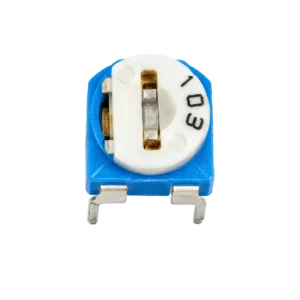
10K Trimmer Potentiometer 103 – 3 Pin Blue Preset
The 10K Trimmer Potentiometer 103 – 3 Pin Blue Preset is a compact, adjustable resistor designed for electronic circuit calibration, voltage adjustment and signal-level control. Featuring a nominal resistance of 10kΩ, a white screwdriver-operated adjustment dial and three PCB mounting terminals, this component is ideal for DIY electronics, Arduino projects and circuit prototyping.
Key Features:
- 10kΩ nominal resistance (10,000 ohms)
- Resistance code: 103
- Compact blue trimmer potentiometer
- White screwdriver-adjustable dial
- Three terminals for potentiometer or variable-resistor operation
- Through-hole PCB mounting
- Suitable for voltage dividers and analog signal adjustment
- Useful for sensor threshold and circuit calibration applications
- Reusable adjustment for electronic prototypes
- Suitable for Arduino, robotics and educational electronics projects
Package Includes: 1 × 10K Trimmer Potentiometer 103 – 3 Pin Blue Preset.
Important: This is a passive adjustable resistor, not a voltage regulator or power supply. Its exact resistance tolerance, power rating and adjustment range should be verified from the supplied component specifications.
Buy the 10K Trimmer Potentiometer online from Yagobotix with shipping across India and same-day delivery options in Surat.
SKU: YGB-POT-TRIM-103-10K
There are no reviews yet.