


18650 Battery Holder – 2 Cell, 7.4V Series with Wire Leads
The 18650 Battery Holder – 2 Cell, 7.4V Series with Wire Leads is a compact battery holder designed to accommodate two rechargeable 18650 lithium-ion cells for portable electronics, robotics and DIY projects.
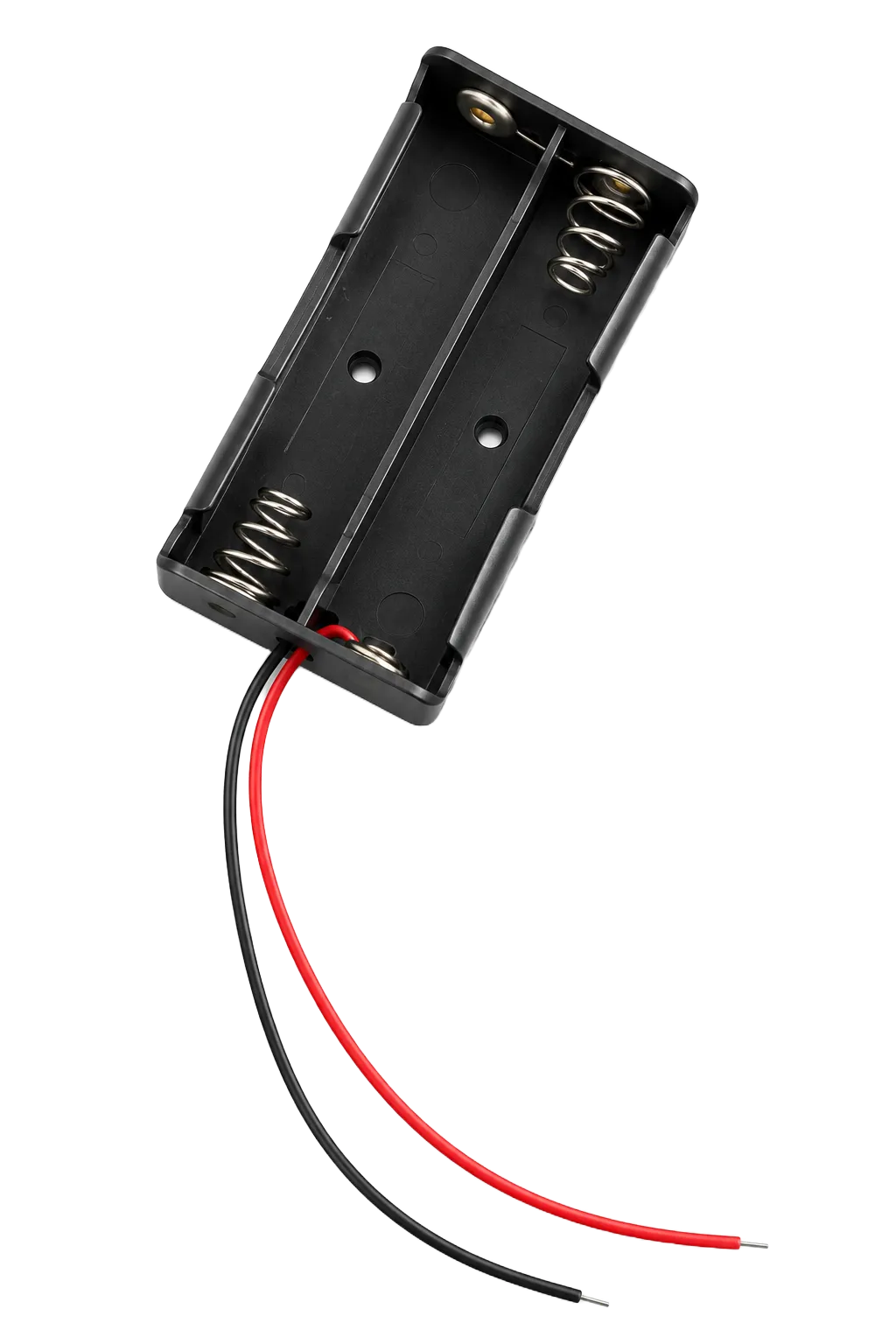
Featuring a black plastic housing, metal spring contacts and pre-attached red and black wires, this dual-slot holder provides a convenient way to connect a pair of compatible 18650 batteries without soldering directly to the cells.
Key Features:
- Holds 2 × 18650 lithium-ion batteries
- Standard 2S series configuration
- 7.4V nominal output with two 3.7V cells
- Up to 8.4V with fully charged cells
- Pre-attached red and black output wires
- Metal spring contacts for battery installation
- Lightweight black plastic housing
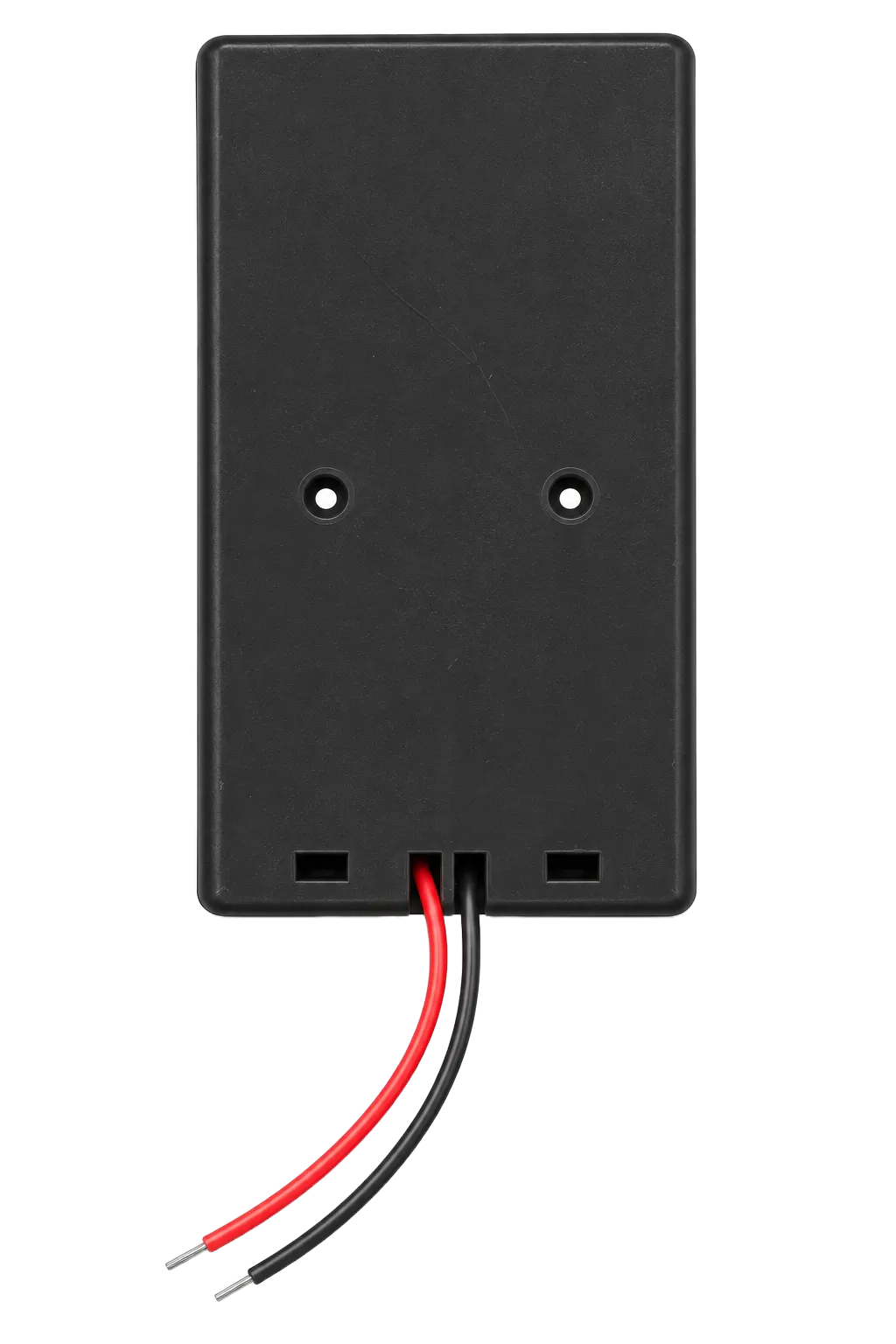
- Two mounting holes for secure installation
- Suitable for Arduino robotics power projects with appropriate voltage regulation
- Useful for portable electronics and DIY battery packs
- No direct soldering to battery cells required
- Batteries can be inserted and removed
- Compact dual-slot design
- Suitable for electronics and STEM projects
Package Includes: 1 × 18650 Battery Holder – 2 Cell with Wire Leads.
Note: Batteries, charger, BMS and voltage regulator are not included. The holder does not provide charging, overcharge protection or over-discharge protection. Use matched cells, correct polarity and appropriate 2S lithium-ion battery protection and charging equipment.
Buy the 18650 Battery Holder 2 Cell online from Yagobotix for robotics, Arduino projects and DIY electronics.
18650 Battery Holder – 2 Cell, 7.4V Series with Wire Leads
1. What Is an 18650 Battery Holder 2 Cell?
The 18650 Battery Holder 2 Cell is a battery-holding accessory designed to accommodate two cylindrical 18650 rechargeable lithium-ion batteries.
It features a black plastic body, metal spring contacts and pre-attached red and black connecting wires.
In a standard series-connected configuration, two 3.7V lithium-ion cells provide approximately 7.4V nominal output.
The holder makes it convenient to insert, remove and replace batteries without directly soldering wires to the cells.
It is useful for robotics projects, portable electronic devices, battery-powered experiments and compatible DC circuits.
Important: The battery holder is a passive electrical accessory. It does not contain a battery charger, voltage regulator or battery management system.
2. What Can You Build With a 2 Cell 18650 Battery Holder?
This 18650 battery holder can be used in projects such as:
- Battery-powered robotics
- Arduino robot cars
- Portable electronics
- DIY rechargeable power systems
- Motor driver projects
- Wireless sensor projects
- Electronics prototyping
- Portable LED lighting
- Battery-operated alarm systems
- DC electronics experiments
- IoT devices with voltage regulation
- Educational battery circuits
- Small automation prototypes
- STEM learning projects
- Rechargeable battery pack demonstrations
Always verify the voltage and current requirements of the connected device.
3. Who Is It For?
The 2 Cell 18650 Battery Holder is suitable for:
- Arduino enthusiasts
- Robotics students
- Electronics engineering students
- DIY electronics makers
- STEM educators
- Embedded system developers
- Science project creators
- Electronics hobbyists
- Battery circuit learners
- Prototype developers
It is particularly useful for understanding series connections, DC power supplies and portable electronic circuits.
4. How Does an 18650 Battery Holder Work?
The holder provides two battery compartments with conductive contacts.
When compatible batteries are inserted with the correct polarity, their terminals connect through the holder’s metal contacts.
In a 2S series configuration, the voltage of each battery adds together.
Battery 1
Provides approximately 3.7V nominal when using a conventional lithium-ion cell.
Battery 2
Provides approximately 3.7V nominal.
Combined Output
The two batteries provide approximately 7.4V nominal in series.
When both are fully charged to 4.2V, the combined voltage is 8.4V.
Output Wires
The red and black wires provide the battery pack’s external electrical connections.
Working Principle
18650 Cell 1 (3.7V) + 18650 Cell 2 (3.7V) → Series Connection → 7.4V Nominal DC Output
The holder does not regulate the output voltage, so the actual voltage changes with the batteries’ state of charge.
5. Technical Specifications
| Specification | Details |
|---|---|
| Product Type | Dual 18650 Battery Holder |
| Battery Size | 18650 |
| Number of Slots | 2 |
| Connection | Series (2S), verify supplied unit |
| Typical Nominal Voltage | 7.4V |
| Fully Charged Voltage | 8.4V |
| Battery Chemistry | Compatible cylindrical Li-ion cells |
| Output Wires | Red and Black |
| Housing Colour | Black |
| Housing Material | Insulating Plastic |
| Contact Type | Metal Spring Contacts |
| Mounting | Two mounting holes |
| On/Off Switch | No |
| Battery Protection Circuit | No |
| Built-in Charger | No |
| Voltage Regulator | No |
| Maximum Current Rating | Not verified |
| Wire Length | Not verified |
| Physical Dimensions | Not verified |
| Battery Compatibility | Check cell length and terminal style |
| Quantity | 1 Holder |
Important Technical Notes
- Use two compatible 18650 cells of the same chemistry, type and similar condition.
- Observe the polarity markings inside the holder.
- Verify the actual red and black lead polarity before connecting electronic devices.
- Do not connect the output directly to 3.3V or 5V devices that cannot tolerate higher voltages.
- Use a suitable voltage regulator when required.
- Use an appropriate 2S battery management/protection arrangement.
- A dedicated 2S lithium-ion charging system is required for charging the pack.
- Do not short-circuit the output wires.
- Do not insert damaged or swollen cells.
- The holder itself does not provide battery charging or protection.
- Confirm physical fit before using protected or unusually long 18650 cells.
6. 18650 Battery Holder Wiring and Polarity
The holder has two output wires.
| Wire | Typical Function |
|---|---|
| Red | Positive (+) |
| Black | Negative (−) |
Red Wire
Normally provides the positive output of the battery pack.
Black Wire
Normally provides the negative output or ground connection.
Battery Orientation
The two battery slots have spring contacts at opposite ends, consistent with a typical series arrangement.
Follow the polarity markings in the holder and verify the connection using a multimeter.
Important
Never rely only on wire colours when connecting a battery holder for the first time.
Confirm polarity before connecting the holder to an Arduino, motor driver, charging circuit or other device.
7. How to Connect an 18650 Battery Holder to Arduino Uno
A standard Arduino Uno R3-compatible board can accept an appropriate external input through its DC power jack or VIN input.
A two-cell lithium-ion battery pack provides approximately 7.4V nominal and up to 8.4V fully charged, which is within the commonly recommended 7–12V external input range for standard Uno R3 designs.
However, the battery pack’s voltage falls as it discharges, and the board’s regulator may not maintain stable operation at lower input voltages.
Required Components
- 1 × 2 Cell 18650 Battery Holder
- 2 × Suitable 18650 Batteries
- 1 × Arduino Uno R3-Compatible Board
- Appropriate 2S battery protection arrangement
- Suitable external power connector
- Multimeter
Connection Procedure
- Confirm the holder uses a series connection.
- Verify battery polarity and output wiring.
- Install two suitable, matched 18650 batteries.
- Measure the output voltage using a multimeter.
- Connect the output through the appropriate protected battery system.
- Use the correct input connector or suitably regulated power supply for the Arduino.
- Verify that the Arduino powers on normally.
Important
Do not connect the unregulated 2S battery pack directly to Arduino’s 5V or 3.3V pins.
A barrel connector with suitable polarity, adequate current rating and a compatible plug size is required when using the DC power jack.
8. Arduino Example Code – Battery Voltage Monitoring
An Arduino can monitor a battery pack’s voltage using a properly designed resistor divider.
A resistor divider reduces the battery voltage before it reaches the Arduino analog input.
Required Components
- 1 × Arduino Uno
- 1 × 2 Cell 18650 Battery Holder
- 2 × Suitable 18650 Batteries
- 1 × 30kΩ Resistor
- 1 × 10kΩ Resistor
- Jumper Wires
- Appropriate 2S battery protection
Voltage Divider
Connect the battery positive through the 30kΩ resistor to Arduino A0.
Connect the 10kΩ resistor between A0 and GND.
Connect battery negative to Arduino GND.
The resistor divider reduces 8.4V to approximately 2.1V at A0.
Arduino Code
const int batteryPin = A0;

const float referenceVoltage = 5.0;
const float R1 = 30000.0;
const float R2 = 10000.0;

void setup() {
  Serial.begin(9600);
}

void loop() {
  int sensorValue = analogRead(batteryPin);

  float pinVoltage =
      sensorValue * (referenceVoltage / 1023.0);

  float batteryVoltage =
      pinVoltage * ((R1 + R2) / R2);

  Serial.print("Battery Voltage: ");
  Serial.print(batteryVoltage, 2);
  Serial.println(" V");

  delay(1000);
}
Expected Output
Arduino Serial Monitor displays the approximate battery pack voltage.
Important
This code assumes a regulated 5V Arduino ADC reference. For accurate measurement, calibrate the ADC reference and resistor values.
The Arduino must have a suitable power source, and its analog input must never exceed the permitted voltage.
Voltage monitoring alone is not a substitute for 2S battery protection or individual cell monitoring.
9. Beginner Project: Battery-Powered Arduino Robot
Project Objective
Build a small robot that operates using two rechargeable 18650 batteries.
Components Required
- 1 × Arduino Uno
- 1 × 2 Cell 18650 Battery Holder
- 2 × Compatible 18650 Batteries
- 1 × Suitable 2S BMS / Battery Protection System
- 1 × Compatible Motor Driver
- 2 × BO Motors
- 2 × Robot Wheels
- 1 × Robot Chassis
- Jumper Wires
- Suitable voltage regulation, if required
Project Working
- The two batteries provide DC electrical energy.
- The holder provides the physical battery connection.
- The battery protection system provides the appropriate electrical safeguards.
- The power circuit supplies the Arduino and motor driver through suitable connections.
- The Arduino sends control signals to the motor driver.
- The motor driver operates the BO motors.
- The robot moves according to its uploaded program.
What Students Learn
- Series battery connections
- Battery polarity
- DC voltage measurement
- Portable power supplies
- Motor driver circuits
- Robotics power management
- Arduino control systems
- Lithium-ion battery safety
10. Related Products
Complete your electronics projects with:
- Arduino Uno R3 Compatible Board
- Arduino Uno R3 SMD Board
- Arduino Nano Development Board
- BO Motor
- 65mm BO Motor Wheel
- DC Motor Fan
- Motor Driver Module
- Female DC Power Supply Connector
- DC Power Jack Connector with Screw Terminal
- Jumper Wires
- Breadboard
- Suitable Battery Management System
- Suitable DC Voltage Regulator
Use only related products that are available in the Yagobotix catalogue.
11. Related Tutorials
Explore these electronics learning topics:
- How to Use a 2 Cell 18650 Battery Holder
- Series vs Parallel Battery Connections
- How to Measure Battery Voltage
- 18650 Battery Holder Polarity Explained
- How to Power Arduino Using Batteries
- What Is a 2S Battery Pack?
- What Is a Lithium-Ion BMS?
- How to Build a Battery-Powered Robot
- DC Voltage Regulation for Arduino
- Battery Safety for Electronics Projects
- How to Connect a Battery to a Motor Driver
- How to Choose a Suitable Battery Charger
12. Frequently Asked Questions
What is an 18650 Battery Holder 2 Cell?
It is a holder designed to accommodate two 18650 cylindrical batteries.
How many batteries does this holder support?
Two 18650 batteries.
Are batteries included?
No. Batteries must be purchased separately.
What is the output voltage?
For a 2S configuration using two 3.7V lithium-ion cells, the nominal output is 7.4V.
What is the maximum voltage?
Two conventional lithium-ion cells charged to 4.2V each provide a combined 8.4V.
Does the holder provide constant 7.4V?
No. Output voltage varies as the batteries discharge.
Are the batteries connected in series or parallel?
This design appears intended for a series connection. Verify the actual wiring before use.
Does it have red and black wires?
Yes. The photographed holder includes red and black leads.
Does it have a built-in switch?
No switch is visible on this version.
Does it include a BMS?
No. The holder has no built-in battery management system.
Does it charge the batteries?
No. It is only a battery holder.
Can I use a TP4056 module to charge both cells in series?
No. A conventional TP4056 module is intended for a single lithium-ion cell, not a two-cell series pack.
Can I use it with Arduino Uno?
Yes, with appropriate power connections, voltage compatibility and battery protection.
Can I connect it directly to an Arduino 5V pin?
No. A 2S lithium-ion pack can exceed 5V and may damage the board.
Can it power a DC motor?
Yes, if the motor and driver are rated for the battery pack’s voltage and current.
Can it power an ESP32?
Yes, through a suitable voltage regulator and protected power arrangement.
Can I use two different 18650 batteries?
Using mismatched cells in a series pack is not recommended.
Can I use AA batteries?
No. This holder is designed for 18650-size cells.
Can I use protected 18650 batteries?
Only if their physical dimensions and terminal geometry fit the holder correctly.
Does it have mounting holes?
Yes. Two mounting holes are visible in the images.
Can it be used for a robot car?
Yes. It is useful for battery-powered robot prototypes with suitable electrical protection and regulation.
Is the holder waterproof?
No waterproof rating has been verified.
What is the wire length?
The exact lead length has not been confirmed.
Where can I buy a 2 Cell 18650 Battery Holder in Surat?
You can order the 18650 Battery Holder 2 Cell from Yagobotix, with shipping across India and local delivery options in Surat.
13. What Is Included?
Package Includes:
- 1 × 18650 Battery Holder – 2 Cell with Wire Leads
The holder includes:
- Black plastic housing
- Two 18650 battery compartments
- Metal spring contacts
- Red connecting wire
- Black connecting wire
- Two mounting holes
Not Included:
- 18650 Batteries
- Battery Charger
- Battery Management System
- Voltage Regulator
- Arduino Board
- Motor Driver
- Connecting Terminals
14. Compatibility
Battery Compatibility
Designed for standard cylindrical 18650 cells.
Check the actual cell dimensions, particularly when using protected or button-top batteries.
Arduino Boards
Suitable for Arduino-powered projects when the output voltage is connected through an appropriate power input or regulator.
Robotics
Can be used in battery-powered robot prototypes, subject to the current requirements of motors and motor drivers.
ESP32 and ESP8266
Suitable only when paired with appropriate voltage conversion and protection.
Portable Electronics
Can be used in projects requiring a compatible battery voltage and electrical supply.
Battery Management
A correctly selected 2S lithium-ion BMS and charging arrangement are required for safe rechargeable battery pack operation.
Important
The holder itself does not limit current, regulate voltage, balance cells, prevent overcharging or protect against deep discharge.
15. Buy 18650 Battery Holder 2 Cell Online in India
Power your DIY electronics and robotics projects with the 18650 Battery Holder – 2 Cell, 7.4V Series with Wire Leads from Yagobotix.
Designed to hold two rechargeable 18650 lithium-ion cells, this battery holder features a compact black housing, metal spring contacts and pre-attached output wires.
It is useful for Arduino robot cars, portable electronics, motor driver systems and educational battery experiments.
Why Choose Yagobotix?
- Two-slot 18650 battery holder
- Convenient battery insertion and removal
- Pre-attached red and black wires
- Compact plastic housing
- Metal spring contacts
- Suitable for robotics and DIY electronics
- Shipping across India
- Local delivery options in Surat
Package Includes: 1 × 18650 Battery Holder – 2 Cell with Wire Leads. Batteries and battery protection circuitry are sold separately.
Add the 18650 Battery Holder to your cart and build your next portable electronics project with Yagobotix!
Based on 0 reviews
Only logged in customers who have purchased this product may leave a review.
Related products
-
-
Battery Holders, Power & Batteries
4 AA Battery Holder with Wire Leads – 6V DC Battery Case
The 4 AA Battery Holder with Wire Leads – 6V DC Battery Case is a compact battery holder designed to accommodate four AA batteries and provide portable DC power for robotics, electronic circuits, DIY projects and educational applications.
With four standard 1.5V AA batteries connected in series, it provides a nominal 6V DC output through pre-attached red and black wires.
Key Features:
- Holds 4 standard AA-size batteries
- Nominal 6V DC output with four 1.5V cells
- Supports compatible 1.2V AA NiMH rechargeable cells (4.8V nominal output)
- Pre-attached red and black power wires
- Red wire for positive (+) connection
- Black wire for negative (−) connection
- Black plastic battery holder body
- Metal spring contacts for battery connections
- Four individual AA battery compartments
- Mounting holes for secure installation
- Open-top design for battery installation
- Suitable for small DC motor projects
- Useful for Arduino and robotics power circuits with appropriate voltage regulation
- Ideal for DIY electronics and STEM projects
- Compact, lightweight and reusable holder
Package Includes: 1 × 4 AA Battery Holder with Red and Black Wire Leads.
Important: AA batteries are not included. The holder has no built-in voltage regulator, battery charger or ON/OFF switch. Check your device’s voltage requirements before connecting.
Buy the 4 AA Battery Holder online from Yagobotix for robotics, portable electronics and DIY projects.
SKU: YGB-BAT-HLD-4AA-6V -
Power & Batteries, Power Modules & UPS
Female DC Power Jack Socket – 3 Pin PCB Mount (Black)
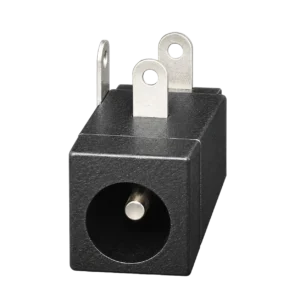
The Female DC Power Jack – 3 Pin PCB Mount (Black) is a compact DC barrel socket designed to connect compatible external DC power adapters to electronic circuits and printed circuit boards. It features a durable black insulating housing, metal contacts and three through-hole solder terminals.
Key Features:
- Female DC barrel power connector
- 3-pin PCB-mount design
- Compatible with matching male DC barrel plugs
- Metal terminals for soldered electrical connections
- Centre contact and outer sleeve contact
- Third terminal typically used as a switched contact
- Compact black plastic housing
- Suitable for PCB power-input connections
- Useful for Arduino-related circuits, robotics and DIY electronics projects
- Reusable DC adapter connection without directly soldering adapter wires
Connector Size: Commonly 5.5 × 2.1 mm; confirm compatibility with the intended male plug before installation.
Package Includes: 1 × Female DC Power Jack Socket – 3 Pin (Black).
Important: This is a passive connector, not a voltage regulator or power supply. Use only with an appropriately rated DC adapter and verify the actual terminal connections before soldering.
Buy the Female DC Power Jack online from Yagobotix with shipping across India and same-day delivery or pickup available in Surat.
SKU: YGB-CON-DCJ-F-3P-BLK
There are no reviews yet.