


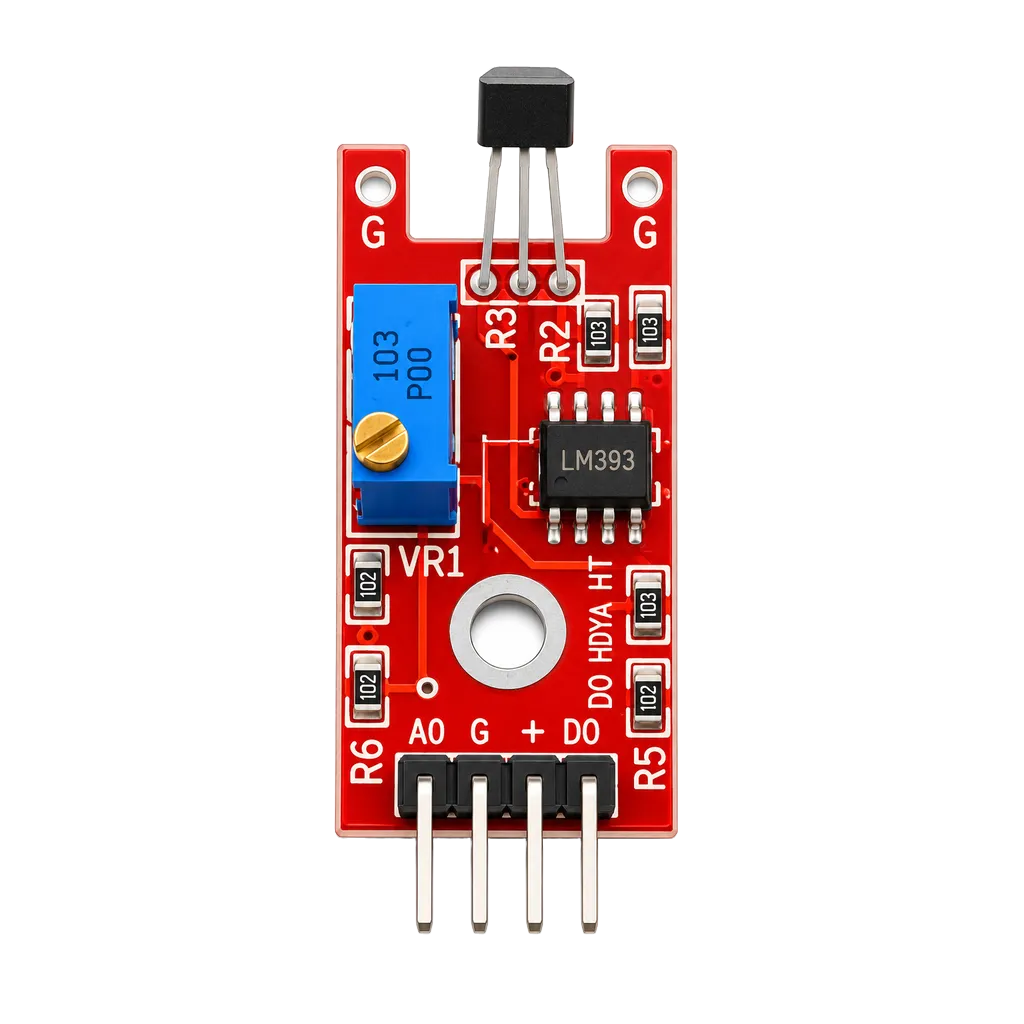
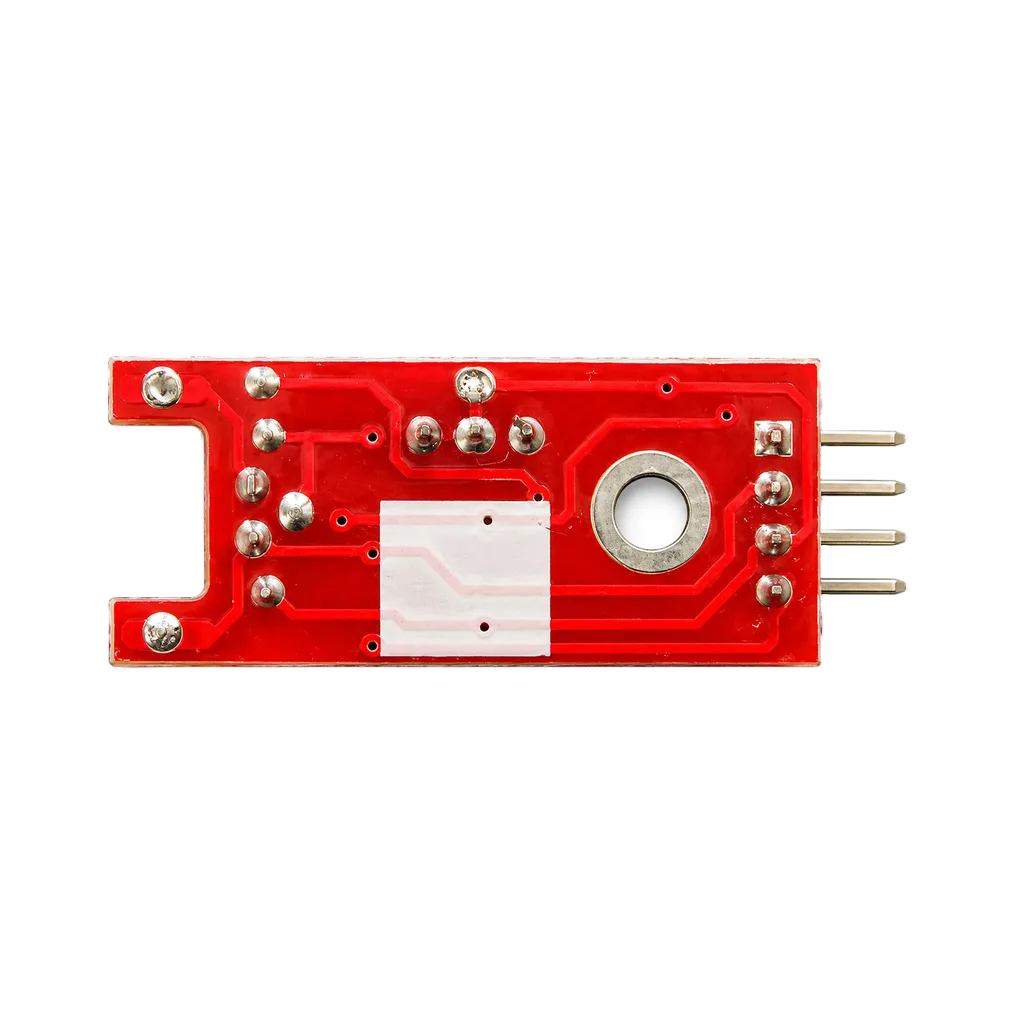
KY-024 Linear Magnetic Hall Effect Sensor Module – Red (4 Pin)
The KY-024 Linear Magnetic Hall Effect Sensor Module is a 4-pin magnetic field detection module featuring an LM393 comparator, analog and digital outputs, and an adjustable detection threshold. Its linear Hall sensing element responds to changes in magnetic field strength and polarity, making it suitable for Arduino, ESP32, robotics and DIY electronics projects.
Key Features:
- Linear Hall effect magnetic sensing
- LM393 comparator IC
- Analog (AO) and digital (DO) outputs
- Adjustable digital detection threshold
- Typical operating voltage: 3.3–5V DC
- Onboard power and output indicator LEDs
- 4-pin interface with red PCB
- Suitable for magnetic proximity, position detection and rotational experiments
Note: A permanent magnet is required for magnetic detection experiments and is not included.
Buy the KY-024 Linear Magnetic Hall Effect Sensor Module online from Yagobotix with shipping across India and same-day delivery or pickup available in Surat.
₹59.00 (incl. GST)
KY-024 Linear Magnetic Hall Effect Sensor Module – RED (4 Pin)
1. What Is a KY-024 Linear Magnetic Hall Effect Sensor Module?
The KY-024 Linear Magnetic Hall Effect Sensor Module is an electronic magnetic sensing module designed to detect changes in magnetic fields using a linear Hall effect sensor.
It features an LM393 comparator circuit, adjustable potentiometer, analog output and digital output.
Unlike a basic digital Hall effect switch, a linear Hall sensor produces a continuously varying analog voltage in response to changes in the magnetic field.
The KY-024 module is suitable for Arduino, ESP32, robotics, magnetic position detection, rotation monitoring and educational electronics projects.
2. What Can You Build With a KY-024 Hall Effect Sensor?
The KY-024 Linear Magnetic Hall Effect Sensor Module can be used in projects such as:
- Magnetic field detection experiments
- Arduino magnetic proximity indicators
- Magnetic polarity detection experiments
- Contactless position sensing
- Motor rotation counting prototypes
- Digital RPM counters
- Wheel rotation monitoring
- Magnetic door position monitoring
- Magnet-controlled LED indicators
- Robotics magnetic feedback systems
- IoT magnetic monitoring projects
- School science and STEM projects
3. Who Is It For?
The KY-024 Linear Magnetic Hall Effect Sensor Module is suitable for:
- Beginners learning electronics
- School and college students
- Engineering students
- Arduino and ESP32 enthusiasts
- Robotics hobbyists
- IoT project developers
- STEM educators and trainers
- DIY electronics makers
It is particularly useful for understanding magnetic fields, analog signals, voltage comparators, digital detection thresholds and microcontroller programming.
4. How Does a KY-024 Linear Hall Effect Sensor Work?
The KY-024 module uses the Hall effect to detect magnetic fields.
A linear Hall effect sensing element produces an analog voltage that changes according to the strength and direction of the magnetic field component passing through the sensing element.
When no significant magnetic field is present, a typical linear Hall sensor produces an output voltage near half its supply voltage.
Depending on the magnetic pole and orientation, the analog voltage increases or decreases.
The module also includes an LM393 comparator that provides a digital output when the analog sensor signal crosses an adjustable reference threshold.
Working principle:
Magnetic Field → Linear Hall Sensing Element → Analog Signal → LM393 Comparator → Digital Output
Analog Output (AO):
Provides a continuously varying voltage related to the magnetic field.
Digital Output (DO):
Provides a threshold-based HIGH or LOW signal.
Adjustment Potentiometer:
Allows the digital switching threshold to be adjusted. It does not normally change the fundamental sensitivity of the Hall sensing element.
The module is suitable for relative magnetic field measurements but is not a calibrated scientific magnetometer.
5. Technical Specifications
| Specification | Details |
|---|---|
| Product Type | Linear Magnetic Hall Effect Sensor Module |
| Module Model | KY-024 Type |
| PCB Marking | HDV-A H-T |
| Comparator IC | LM393 |
| Hall Sensing Element | Linear Hall effect sensor |
| Common Reference Sensor | 49E / AH49E type |
| Typical Operating Voltage | 3.3–5V DC |
| Analog Output | AO |
| Digital Output | DO |
| Digital Threshold | Adjustable |
| Adjustment Component | Onboard potentiometer |
| Number of Pins | 4 |
| Pin Labels | AO, G, +, DO |
| Indicators | Power and output LEDs |
| PCB Colour | Red |
| Mounting | PCB mounting hole |
| Applications | Magnetic detection, position sensing and rotation monitoring |
Important technical notes:
- Analog readings vary with magnetic field strength, polarity and orientation.
- The digital switching threshold is adjustable using the potentiometer.
- Detection distance depends on the strength and orientation of the magnet.
- The sensor is not designed to detect non-magnetised metal objects.
- Exact sensing-element identification and electrical ratings depend on the supplied hardware.
6. KY-024 Hall Effect Sensor Pinout
The KY-024 Linear Magnetic Hall Effect Sensor Module features four pins.
| Pin | Function |
|---|---|
| AO | Analog magnetic sensing output |
| G | Ground (GND) |
| + | Positive power supply (VCC) |
| DO | Digital magnetic detection output |
When viewing the component side of this module with the Hall sensor at the top and the connection pins facing downward, the pin order from left to right is:
AO → GND → VCC → DO
Always follow the labels printed on the actual PCB before connecting the module.
7. How to Connect a KY-024 Hall Sensor to Arduino
The KY-024 module can be connected to Arduino Uno using four jumper wires.
Required components:
- 1 × KY-024 Linear Magnetic Hall Effect Sensor Module
- 1 × Arduino Uno
- 1 × Permanent magnet
- Jumper wires
Wiring connections:
| KY-024 Sensor | Arduino Uno |
|---|---|
| AO | Analog Pin A0 |
| G | GND |
| + | 5V |
| DO | Digital Pin D2 |
After connecting the module, bring a magnet near the Hall sensing element and observe changes in the analog and digital outputs.
Rotate the magnet or reverse its polarity to observe how the analog readings respond.
8. Arduino Example Code
The following program reads both the analog and digital outputs of the KY-024 Hall Effect Sensor Module.
const int hallAnalogPin = A0;
const int hallDigitalPin = 2;

void setup() {
  pinMode(hallDigitalPin, INPUT);
  Serial.begin(9600);
}

void loop() {
  int analogValue = analogRead(hallAnalogPin);
  int digitalValue = digitalRead(hallDigitalPin);

  Serial.print("Analog Reading: ");
  Serial.print(analogValue);

  Serial.print(" | Digital Reading: ");
  Serial.println(digitalValue);

  delay(200);
}
How to test the sensor:
- Connect the KY-024 sensor to Arduino.
- Upload the program using Arduino IDE.
- Open the Serial Monitor at 9600 baud.
- Observe the analog reading without a nearby magnet.
- Bring a magnet close to the Hall sensing element.
- Reverse the magnet orientation and observe the reading.
- Adjust the onboard potentiometer to change the digital switching threshold.
With a typical 5V linear Hall sensor and Arduino Uno, the no-field analog reading may be near the midpoint of the 10-bit ADC range.
Actual readings depend on the sensor’s characteristics, supply voltage and magnetic environment.
9. Beginner Project: Magnetic Field Detection LED Indicator
Build a simple magnetic detection indicator using the KY-024 module and a 5mm Red LED.
Components required:
- 1 × KY-024 Linear Magnetic Hall Effect Sensor Module
- 1 × Arduino Uno
- 1 × 5mm Red LED
- 1 × 330Ω resistor
- 1 × Permanent magnet
- Breadboard
- Jumper wires
Wiring connections:
- KY-024 AO → Arduino A0
- KY-024 + → Arduino 5V
- KY-024 G → Arduino GND
- LED anode → Arduino D8 through a 330Ω resistor
- LED cathode → Arduino GND
Example Arduino code:
const int hallPin = A0;
const int ledPin = 8;

int baseline = 0;

// Example ADC deviation threshold.
// Adjust after testing.
const int threshold = 35;

void setup() {
  pinMode(ledPin, OUTPUT);
  Serial.begin(9600);

  delay(500);

  // Calibrate with no magnet nearby.
  long sum = 0;

  for (int i = 0; i < 100; i++) {
    sum += analogRead(hallPin);
    delay(5);
  }

  baseline = sum / 100;
}

void loop() {
  int sensorValue = analogRead(hallPin);

  int difference = abs(sensorValue - baseline);

  if (difference > threshold) {
    digitalWrite(ledPin, HIGH);
  } else {
    digitalWrite(ledPin, LOW);
  }

  Serial.print("Magnetic Deviation: ");
  Serial.println(difference);

  delay(100);
}
Project operation:
- The Arduino records the initial sensor reading without a magnet.
- A nearby magnet changes the analog sensor output.
- When the reading changes sufficiently from the baseline, the LED turns ON.
- Removing the magnet allows the LED to turn OFF.
The threshold value is illustrative and must be adjusted for the particular sensor and magnet.
This project teaches analog inputs, sensor calibration, magnetic detection and conditional programming.
10. Related Products
Complete your electronics project with:
- LM393 Hall Effect Sensor Module – 4 Pin
- Magnetic Reed Switch Sensor Module
- Arduino Uno R3 Compatible Programmable Board
- ESP32 Development Board
- BO Motor Dual Shaft
- 65mm BO Motor Wheel
- SW-420 Vibration Sensor Module
- 5mm Red LED
- 5mm Green LED
- 5mm LED Assorted Pack of 5
- TM1637 4-Digit Display Module
- MAX7219 8×8 LED Matrix Module
- Breadboard
- Jumper Wires
- 330Ω Resistor
11. Related Tutorials
Explore these electronics learning topics:
- How to Use a KY-024 Hall Effect Sensor with Arduino
- Understanding Linear Hall Effect Sensors
- KY-024 vs A3144 Hall Effect Sensor
- How to Detect Magnetic Polarity Using Arduino
- How to Connect a KY-024 Sensor to ESP32
- Analog vs Digital Hall Effect Sensors
- How to Adjust the KY-024 Detection Threshold
- How to Build a Magnetic Field Indicator
- How to Measure Motor RPM Using a Hall Sensor
- Magnetic Reed Switch vs Hall Effect Sensor
12. Frequently Asked Questions
What is a KY-024 Linear Magnetic Hall Effect Sensor Module?
The KY-024 is an electronic magnetic sensing module that provides analog and digital outputs for detecting magnetic fields.
What is the difference between KY-024 and a digital Hall effect sensor?
The KY-024 uses a linear Hall sensing element that provides a varying analog output. A basic digital Hall effect switch primarily provides an ON/OFF signal.
What is the operating voltage of the KY-024?
Typical KY-024 modules operate from approximately 3.3V to 5V DC.
Does the KY-024 provide analog output?
Yes. The AO pin provides a voltage that changes according to the magnetic field sensed by the linear Hall element.
Does the KY-024 have digital output?
Yes. The DO pin provides a threshold-based digital signal generated by the onboard comparator circuit.
Can I adjust the sensitivity?
The onboard potentiometer allows the digital switching threshold to be adjusted. It does not necessarily change the analog sensor’s fundamental sensitivity.
Can this sensor detect both magnetic poles?
A typical linear Hall sensor responds differently to opposite magnetic field directions, allowing relative polarity detection when the magnet and sensor are correctly oriented.
Can the KY-024 measure magnetic field strength?
It can provide relative magnetic field information through its analog output. Accurate measurements in gauss or tesla require calibration and verified sensor specifications.
Can I connect the KY-024 to Arduino?
Yes. The analog output can be connected to an Arduino analog input, while the digital output can be connected to a digital input.
Can I use the KY-024 with ESP32?
Yes. The module can be used with ESP32 when its supply voltage and output signals remain within the controller’s electrical limits.
Can I use this sensor to measure motor RPM?
Yes. A magnet attached to a rotating component can generate periodic detection events that a microcontroller can count. Appropriate threshold adjustment and pulse counting are required.
Can the KY-024 detect ordinary metal objects?
No. Hall effect sensors respond to magnetic fields rather than detecting all metal objects.
What is the function of the LM393 IC?
The LM393 comparator compares the sensing signal with a reference threshold and generates the digital output.
Does this module require a magnet?
A suitable magnetic field is required for magnetic detection experiments. A permanent magnet is commonly used for testing.
Where can I buy a KY-024 Linear Magnetic Hall Effect Sensor Module in Surat?
You can purchase the KY-024 Hall Effect Sensor Module online from Yagobotix with same-day delivery and pickup available in Surat.
13. What Is Included?
- 1 × KY-024 Linear Magnetic Hall Effect Sensor Module – Red PCB, 4 Pin
Arduino boards, magnets, breadboards, LEDs, resistors and jumper wires are not included.
14. Compatibility
The KY-024 Linear Magnetic Hall Effect Sensor Module can be used with suitable electronic systems involving:
- Arduino Uno
- Arduino Nano
- Arduino Mega
- ESP32
- ESP8266 NodeMCU
- Raspberry Pi
- STM32 development boards
- Other compatible microcontrollers
- Custom magnetic detection circuits
For 3.3V microcontrollers, use a compatible module supply voltage and verify the analog and digital output levels before connection.
Do not connect a 5V output directly to GPIO or ADC pins that are not 5V tolerant.
Raspberry Pi requires an external ADC to measure the analog output.
15. Buy KY-024 Linear Magnetic Hall Effect Sensor Module Online in India
Add magnetic field detection and contactless sensing capabilities to your next electronics project with the KY-024 Linear Magnetic Hall Effect Sensor Module from Yagobotix.
Featuring analog and digital outputs, an LM393 comparator and adjustable digital threshold, this sensor module is ideal for Arduino experiments, robotics, magnetic proximity monitoring and educational electronics.
Whether you are studying the Hall effect, building a magnetic position detector or developing a rotational monitoring prototype, the KY-024 provides a practical solution for your project.
Why Choose Yagobotix?
- Sensors and modules for Arduino, ESP32 and robotics
- Electronic components for students, hobbyists and engineers
- Shipping across India
- Same-day delivery available in Surat
- Same-day pickup available in Surat
Same-day services are subject to stock availability, delivery coverage and applicable order cut-off times.
Add the KY-024 Linear Magnetic Hall Effect Sensor Module to your cart and start building your next electronics project with Yagobotix!
Based on 0 reviews
Only logged in customers who have purchased this product may leave a review.
Related products
-
Sensors, Light & Sound
LM393 LDR Light Sensor Module – 3 Pin
- The LDR Light Sensor Module is a compact light detection sensor featuring a Light Dependent Resistor (LDR), an LM393 comparator and an adjustable light detection threshold. It is ideal for automatic lighting systems, day and night detection, smart streetlight models and DIY electronics projects.Key Features:
- Light Dependent Resistor (LDR) sensing element
- LM393 voltage comparator
- Typical operating voltage: 3.3–5V DC
- Digital output (DO)
- Adjustable light detection threshold
- Onboard power and output LED indicators
- Compact blue PCB with 3-pin interface
- Suitable for Arduino, ESP32 and other compatible microcontrollers
Buy the LDR Light Sensor Module online from Yagobotix with shipping across India and same-day delivery or pickup available in Surat.
SKU: YGB-SEN-LDR-03 - The LDR Light Sensor Module is a compact light detection sensor featuring a Light Dependent Resistor (LDR), an LM393 comparator and an adjustable light detection threshold. It is ideal for automatic lighting systems, day and night detection, smart streetlight models and DIY electronics projects.Key Features:
-
Sensors
Magnetic Reed Switch Sensor Module – 4 Pin
The Magnetic Reed Switch Sensor is a compact magnetic detection module designed to detect the presence or absence of a nearby magnet. Featuring a glass reed switch, analog and digital outputs and an adjustable detection threshold, it is ideal for door monitoring, contactless switching, position detection and DIY electronics projects.
Key Features:
- Glass-encapsulated magnetic reed switch
- Analog (AO) and digital (DO) outputs
- Adjustable digital detection threshold
- Compact red PCB design
- Simple 4-pin interface
- Onboard LED indicators
- Suitable for Arduino, ESP32 and other compatible microcontrollers
Buy the Magnetic Reed Switch Sensor online from Yagobotix with shipping across India and same-day delivery or pickup available in Surat.
SKU: YGB-SEN-REED-04 -
Gas & Environment, Sensors
Flame Sensor Module for Arduino | Fire Detection & Flame Detection Projects
-26% Gas & Environment, Sensors
Flame Sensor Module for Arduino | Fire Detection & Flame Detection Projects
- Detects flame and fire sources using infrared sensing
- Adjustable sensitivity with onboard potentiometer
- Digital output with clear LED indication
- Ideal sensor for beginner STEM and safety-based projects
SKU: ygbs04 -
Light & Sound, Sensors
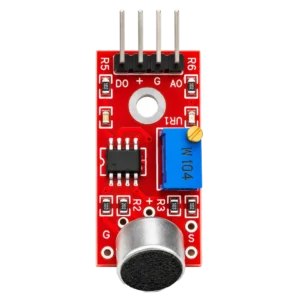
4 Pin Sound Sensor Module – Red PCB (Analog & Digital)
The 4 Pin Sound Sensor Module is a microphone-based sound detection sensor featuring analog and digital outputs, an adjustable detection threshold and a compact red PCB design. It is ideal for sound-activated lights, clap-controlled switches, noise detection experiments and interactive robotics projects.
Key Features:
- Built-in microphone for sound detection
- Analog (AO) and digital (DO) outputs
- Adjustable sound detection threshold
- Red PCB with onboard LED indicators
- Simple 4-pin interface
- Suitable for Arduino, ESP32 and other compatible microcontrollers
Buy the 4 Pin Sound Sensor Module online from Yagobotix with shipping across India and same-day delivery or pickup available in Surat.
SKU: YGB-SEN-SND-04-R
There are no reviews yet.